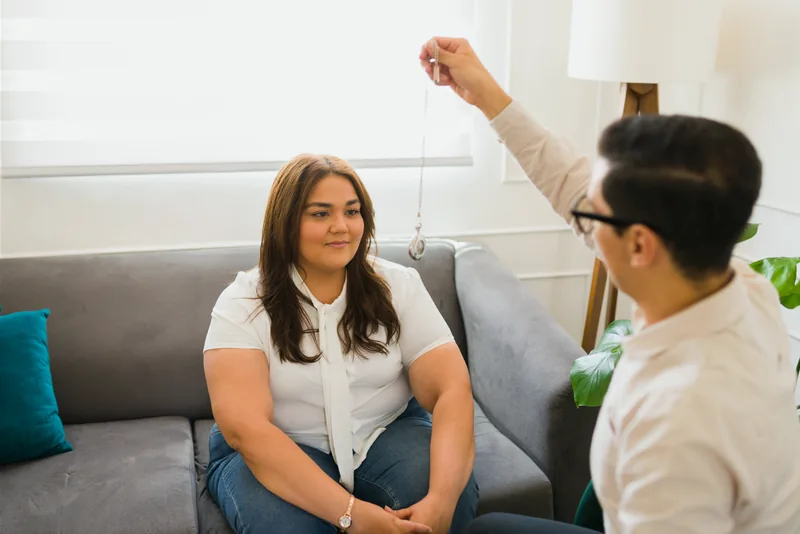
If you’re looking for help with anxiety, you may be weighing up different approaches. This guide explains what to expect from hypnotherapy, how we agree goals and how we review whether it’s helping.
Sessions take place at my home practice in Rugby or online.

Why hypnotherapy may be useful for anxiety
Anxiety is not only a thinking problem. You may know that a situation is safe and still feel your heart race, your stomach tighten or your attention lock onto everything that could go wrong. The response can begin before deliberate thought has caught up.
CBT, counselling, mindfulness, journalling and breathing exercises can all be useful, and they work in different ways across thoughts, feelings, behaviour and the body. Hypnotherapy is not a deeper or better version of those approaches. It offers another route: using focused attention, imagery and rehearsal to work with responses that feel automatic.
You might want to attend a meeting, go somewhere you’ve been avoiding or enjoy your time off. We choose a situation that matters to you, practise a response and review what happens when you try it.
What happens in the first session
I see clients in a cosy home setting in Rugby. You can come to me or we can work online.
The first session starts with conversation. I want to understand what you worry about and how anxiety shows up for you: perhaps as chest tightness or a racing heart, constant mental rehearsal, avoidance, procrastination or some combination. We also talk about when it began or worsened and what you have already tried.
There is paperwork to complete, and time to discuss the concern in your own words. I ask questions so that we can agree a specific focus for the work.
What hypnosis feels like
It is useful to discuss what to expect before you decide to take part.
I guide your attention using my voice. You might feel deeply relaxed, lightly absorbed or simply focused; there is no single sensation you have to produce. You remain aware of what is being said and can speak, move, open your eyes or stop at any point.
You are not unconscious or under anyone’s control. Think of it as sustained, purposeful attention rather than sleep.
We might use imagery to explore what you expect from a situation, rehearse a response or work with an earlier experience that still affects you. I explain what I’m suggesting before we begin. You can read examples of the methods I use before deciding.
At the end, I bring your attention back fully and we talk briefly about what you noticed. We leave enough time for you to feel alert and settled before the session ends. Any useful change is judged by what happens afterwards in daily life, not by how dramatic the session felt.
How quickly will I notice a difference?
We agree how to review progress before we begin, using examples that matter to you.
I do not predict a result from a fixed number of sessions. Instead, we agree what meaningful progress would look like in real life: perhaps a situation feels less sharp, recovery after an anxious episode is shorter, avoidance reduces or intrusive thoughts have less grip. We record a starting point and agree when we will review it. If nothing useful is changing, that matters too, and the plan should be adjusted or another route considered.
We agree an initial plan and when to review it. There is no fixed course you must complete. At the review we decide whether to finish, continue, change the approach or consider another kind of support.
Is it different from counselling or CBT?
They are different approaches, but the boundaries are not as neat as comparison pages sometimes suggest. CBT can work with thoughts, behaviour, emotion and physical responses; counselling can offer space to process experience and understand yourself; hypnotherapy makes deliberate use of focused attention, imagery and suggestion.
Some people explore hypnotherapy after another approach has helped them understand the anxiety but the physical or automatic response still feels stubborn. Others use it as their first therapeutic approach. Neither choice makes one method universally better.
The important questions are whether the approach suits the difficulty, whether you feel comfortable with the practitioner and whether anything useful changes in your life.
What about online sessions?
Online sessions let us work together while you’re in your own space. We can discuss which setting suits you in the free consultation.
The advantages are simple: no journey, a familiar room and more choice for people outside Rugby. The drawbacks can include interruptions, unreliable technology or not having a genuinely private space.
Before working online, we check privacy, your location, what to do if the connection drops and whether there is any reason an in-person or different service would be safer.
You need a private space, a reliable connection and somewhere comfortable to sit. If online work does not feel suitable, I will say so.
A note on suitability
Hypnotherapy is not suitable for everyone, and I treat that boundary as non-negotiable. I do not work with clients who are currently experiencing active psychosis or certain severe mental health conditions. Those situations need appropriate specialist care first.
Please tell me about any diagnosis or current care during the confidential consultation and intake. It helps me decide whether I can offer useful support or whether someone else is better placed to help. Keep clinical details out of ordinary enquiry messages.
For some adults with anxiety-related difficulties, hypnotherapy may be worth considering. The free consultation is where we decide whether it is appropriate for your situation and what a sensible next step might be.
How to ask about a consultation
The first consultation is free. It is a conversation about what has been happening, what you have tried and whether this approach seems sensible. Bring your questions and we’ll see whether working together feels right.
You can read about help with anxiety and stress in Rugby or ask me whether the support I offer fits your situation.
Talk it through with Adel
If you’re looking for help with anxiety in Rugby, tell me what’s been happening and what you’d like to change. We can talk about meeting in person or online.
The first step is a free 30-minute Zoom call. Bring your questions and we’ll see whether working together feels right.
Book a Free Call